

The Main Chunmee Green Tea Producing Regions In China
Sep 16, 2023
The Jiangbei Region
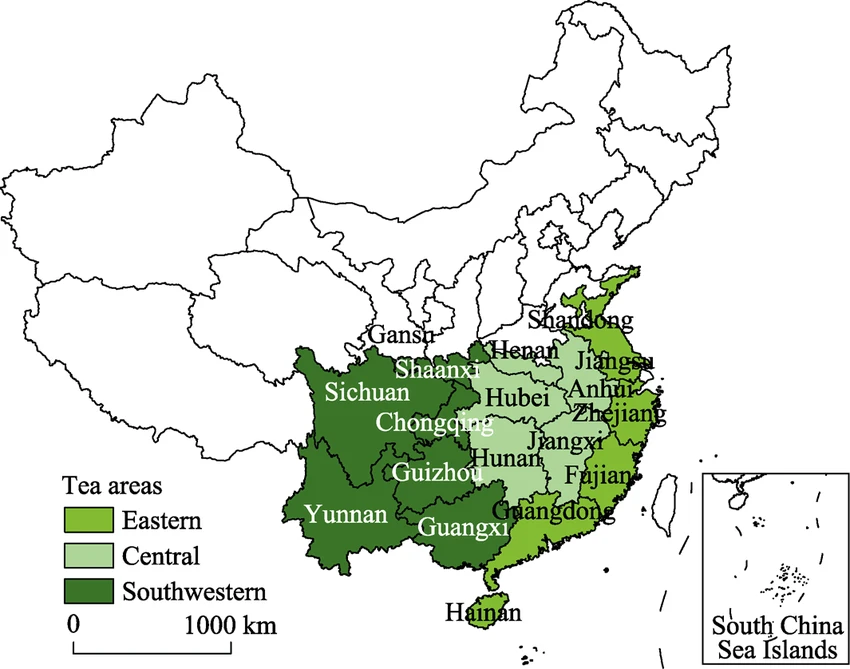
The Jiangbei region is in the north of the Yangtze River, covering provinces like Henan, Shaanxi, Gansu, Shandong, and parts of Anhui, Jiangsu, and Hubei. It is the northernmost tea region in China, and has a varied terrain and a slightly alkaline soil. The annual rainfall is relatively low, and the average annual temperature is around 15 to 16 degrees Celsius. The tea plants in this region are mostly shrub-type medium-leaf and small-leaf varieties, which can endure cold and drought. The from this region are mainly green teas, such as Chunmee Green tea, Xinyang Maojian, Lu’an Guapian, Huoshan Huangya, etc. These teas are famous for their fine, round, smooth, and straight shapes, their high fragrance, strong taste, and green soup color.
The Jiangnan Region
The Jiangnan region is in the south of the Yangtze River, covering provinces like Zhejiang, Hunan, Jiangxi, and parts of Anhui, Jiangsu, and Hubei. It is the main tea region in China, accounting for about two-thirds of the national tea output. The region has a hilly terrain and a fertile soil. The climate is mild and humid, with four distinct seasons. The tea plants in this region are mostly shrub-type specialized varieties and small-leaf varieties, as well as some small-arbor-type medium-leaf and large-leaf varieties. The teas from this region include green teas, black teas, yellow teas, white teas, etc., such as West Lake Longjing, Dongting Biluochun, Junshan Yinzhen, Lushan Yunwu, etc. These teas are well-known for their green color, orchid fragrance, mellow taste, and beautiful shape.
The Southwest Region
The Southwest region is in the west of China, covering provinces like Yunnan, Guizhou, Sichuan, and parts of Tibet. It is the oldest tea region in China, with a history of more than two thousand years. The region has a complex topography, with plateaus and basins as the main features. The altitude varies greatly, resulting in different climatic zones. The soil is rich in organic matter and minerals. Chunmee Green TeaThe tea plants in this region are diverse in types and varieties, including arbor-type large-leaf varieties, shrub-type medium-leaf varieties, and small-leaf varieties. The teas from this region include black teas, green teas, pu’er teas, dark teas, etc., such as Yunnan Dianhong, Mengding Ganlu, Duyun Maojian, Yunnan Pu’er, etc. These teas are characterized by their thick leaves, strong aroma, full-bodied flavor, and dark red soup color.
The South China Region
The South China region is in the south of China, covering provinces like Guangdong, Guangxi, Fujian, Taiwan, Hainan, etc. It is the most suitable region for tea plant growth in China, with a warm and moist climate, abundant rainfall, and rich soil. The tea plant resources in this region are abundant, with various types and varieties of tea plants, such as arbor-type, small-arbor-type, shrub-type, etc. The teas from this region include oolong teas, black teas, green teas, etc., such as Anxi Tieguanyin, Wuyi Rock Tea, Fenghuang Dancong, Jinjunmei, etc. These teas are renowned for their heavy fragrance, smooth taste, bright color, and elegant shape.Chunmee Green Tea
To sum up, the main tea regions in China have different natural conditions and cultural traditions that influence the quality and style of their teas. By understanding the features and characteristics of each region, we can appreciate the diversity and richness of Chinese tea culture.


